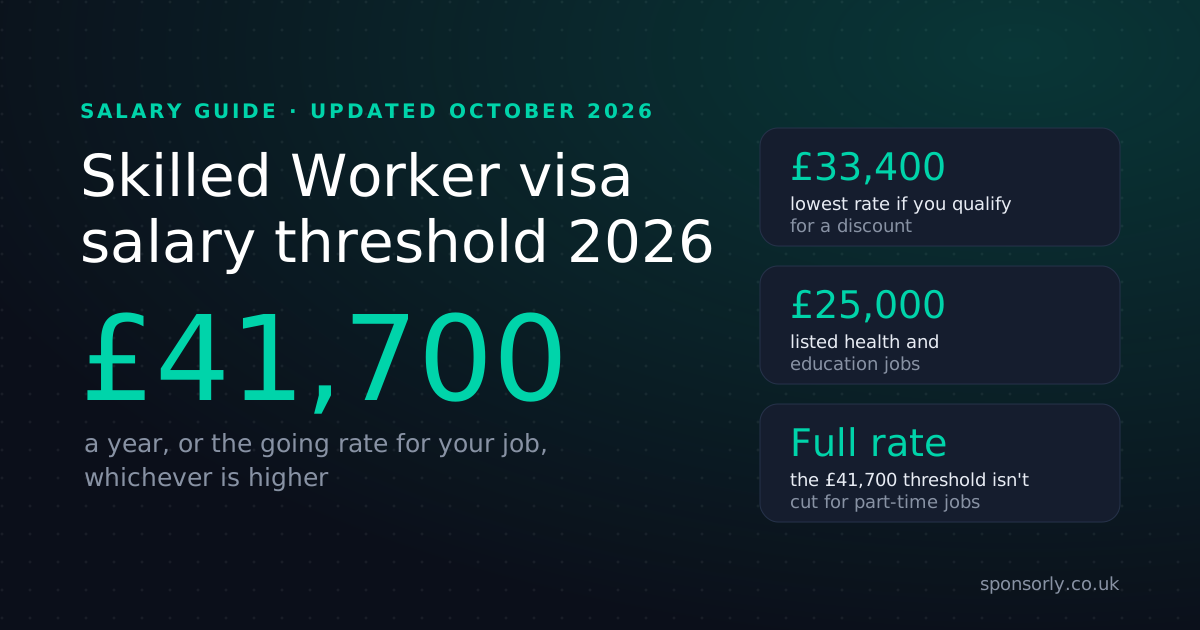
- Most people applying for a Skilled Worker visa in 2026 must be paid at least £41,700 a year, or the going rate for their job, whichever is higher.
- You may be able to earn less, from £33,400, if you're a new entrant, you have a relevant PhD, or your job is on the Immigration Salary List.
- Listed healthcare and education jobs have their own rules, starting at £25,000 or the national pay scale rate.
The two numbers your salary has to beat
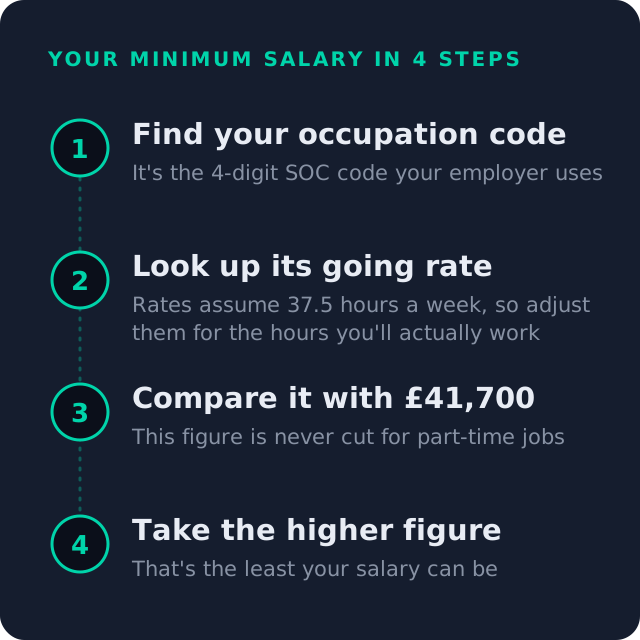
Think of it as two hurdles, and your salary has to clear both.
The first is the general threshold: £41,700 a year for most new applicants. It's the same whatever job you do, and it went up to this level when the Skilled Worker rules changed in July 2025.
The second is the going rate: the typical UK salary for your particular job. Every eligible job has a four-digit occupation code (called a SOC code), and each code has its own going rate, set by the Home Office. A software developer's going rate is very different from a graphic designer's.
Your salary must be at least the higher of the two. If your job's going rate is below £41,700, the £41,700 threshold applies. If it's above, the going rate is your minimum. You can search the eligible jobs and their going rates on our eligible occupations list.
Real examples: what would you need to earn?

Here's how the rules work for a few common jobs, using the going rates that apply in October 2026 for a standard 37.5-hour week:
| Job (occupation code) | Going rate | Minimum salary |
|---|---|---|
| Civil engineer (2121) | £50,400 | £50,400 |
| Programmer or software developer (2134) | £54,700 | £54,700 |
| Chartered or certified accountant (2421) | £49,200 | £49,200 |
| IT quality and testing professional (2136) | £41,200 | £41,700 |
| Software developer who's a new entrant (2134) | 70% of £54,700 | £38,290 |
Look at the testing role: its going rate of £41,200 is below the general threshold, so the £41,700 figure wins. And the new entrant only needs 70% of the going rate, which works out at £38,290, comfortably above the £33,400 floor.
Check your own salary in 30 seconds
Pop in your numbers and we'll show you the minimum that applies to you. You'll find your job's going rate on our eligible occupations list.
A quick estimate for new applicants, not legal advice. It doesn't cover healthcare and education jobs on national pay scales, or people already sponsored before 4 April 2024. Your employer's certificate of sponsorship and the GOV.UK rules decide.
When you can be paid less
Some applicants can use a lower minimum. You still need to meet a share of the going rate, and a floor of at least £33,400.
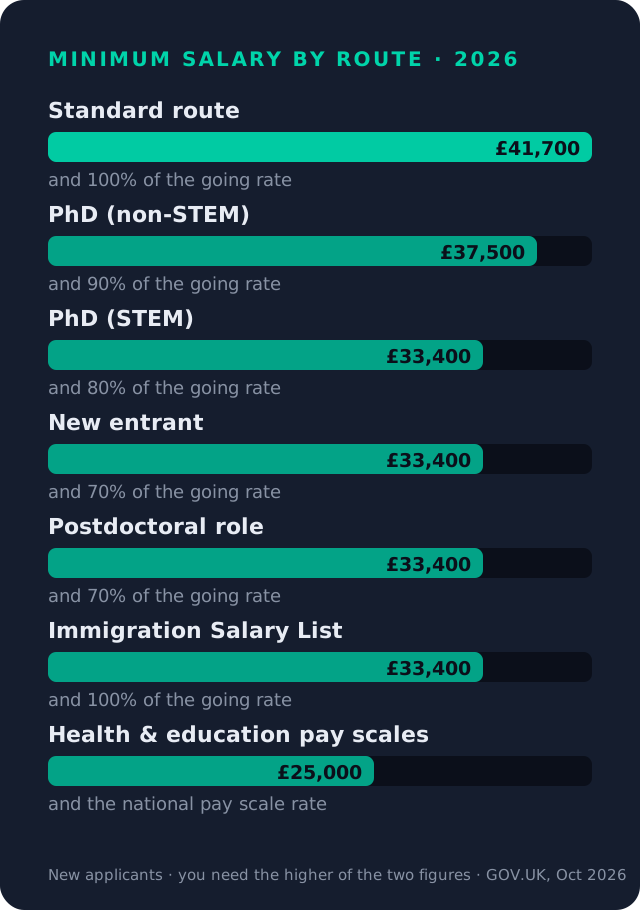
New entrants: 70% of the going rate, and at least £33,400
You usually count as a new entrant if any of these apply to you:
- you're under 26 on the date you apply
- you're in the UK on a Student visa (studying at bachelor's degree level or above) or a Graduate visa, or you've had one in the last 2 years and your most recent visa was one of those or a visit visa
- you're working towards a recognised qualification in a UK regulated profession, or towards full registration or chartered status in your job
There's a time limit: your total stay in the UK on these terms can't be more than 4 years, including any time on a Graduate visa.
A relevant PhD: 80% or 90% of the going rate
If you have a UK PhD, or an equivalent doctorate from abroad, that's relevant to the job, you need 80% of the going rate and at least £33,400 for a STEM subject, or 90% of the going rate and at least £37,500 for any other subject. Your job must be one that qualifies for a PhD discount, and your employer confirms that your PhD is relevant.
Postdoctoral roles: 70% of the going rate, and at least £33,400
This applies to postdoctoral positions in science and higher education, in occupation codes 2111, 2112, 2113, 2114, 2115, 2119, 2162 and 2311. The same 4-year limit applies.
Jobs on the Immigration Salary List: the full going rate, and at least £33,400
If your job is on the Immigration Salary List, you still need the full going rate, but the floor drops to £33,400, and you and your family pay a lower visa fee. Most jobs on the list are due to come off it on 31 December 2026, so check the latest list before you rely on it.
Ask your employer which salary rule they're using before they assign your certificate of sponsorship. It's the document your whole application rests on, so it's worth getting right first time.
Healthcare and education jobs
If your job is on the Home Office's list of healthcare and education occupations, different rules apply. Your salary must be at least £25,000, or the national pay scale rate for your role if that's higher. For healthcare jobs, the rate comes from the NHS pay bands. For teaching and education leadership roles, it comes from the national pay scales. These rates apply whether you work in the public sector or for a private employer.
Many people in health and care jobs apply for the Health and Care Worker visa, a version of the Skilled Worker visa with a lower fee and no Immigration Health Surcharge. Our Skilled Worker visa cost guide compares the two. Note that care worker and senior care worker jobs have been closed to new applicants from outside the UK since 22 July 2025.
What counts towards your salary (and what doesn't)

This is where offers that look fine on paper can fall short. The Home Office only counts your guaranteed basic gross pay, meaning your pay before tax. Your own pension and National Insurance contributions are part of that gross figure, so they count.
Allowances, such as London weighting, count only if they're guaranteed and treated exactly like basic pay for tax, pension and National Insurance.
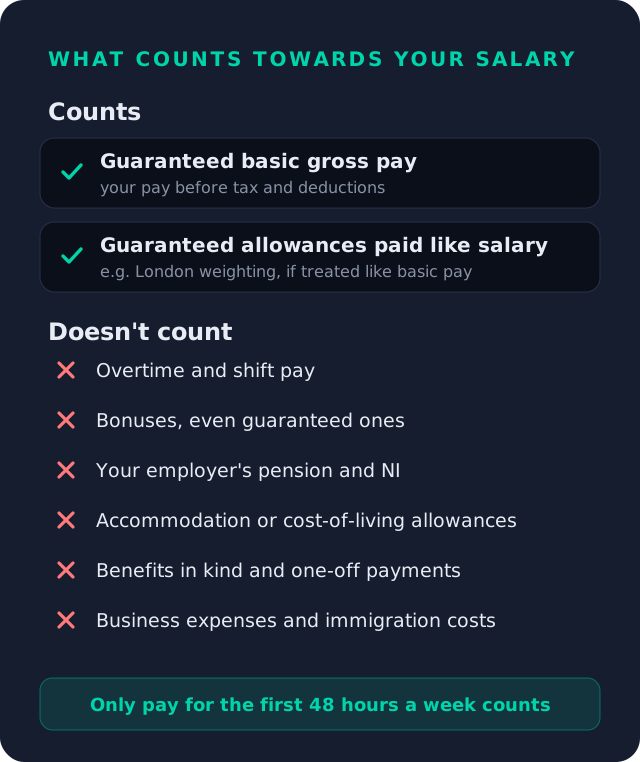
These don't count, even if they're in your contract: overtime and shift pay, bonuses (even guaranteed ones), your employer's pension and National Insurance contributions, accommodation or cost-of-living allowances, benefits in kind, one-off payments such as a "golden hello", and business expenses or immigration costs. If you pay money back to your employer, such as a loan repayment, it's usually taken off your salary for this test.
Already on a Skilled Worker visa?
If you're extending your visa or changing employer, some different rules may apply to you:
- First sponsored before 4 April 2024? If you got the certificate of sponsorship for your first Tier 2 or Skilled Worker visa before 4 April 2024, and you've held Skilled Worker permission ever since, you can be paid the higher of £31,300 or the lower going rate for your job. This applies to applications made before 4 April 2030.
- First sponsored before 22 July 2025? You can usually extend even if your job is a medium-skilled one that's no longer on the main list of eligible jobs.
- Going rates move. The Home Office updates them from time to time, so check your salary against the current rates every time you extend or change jobs.
These groups have extra conditions, so check the GOV.UK guidance for your own situation before you rely on a lower figure.
Your 5-minute salary check before you accept
- Ask your employer which occupation code they'll use, and check it's on the eligible occupations list.
- Look up the going rate for that code and adjust it for your weekly hours.
- Make sure your guaranteed basic pay beats both the going rate and £41,700, or the lower figure you qualify for.
- Ignore overtime, bonuses and any allowance that isn't guaranteed. They don't count.
- Check your employer is a licensed sponsor before you hand in your notice anywhere. Our sponsor licence checker guide shows you how.
Is your employer licensed to sponsor you?
Search more than 120,000 licensed sponsors on the Home Office register. It takes 10 seconds.
Check an employer →Frequently asked questions
What is the minimum salary for a Skilled Worker visa in 2026?
For most new applicants, it's £41,700 a year or the going rate for the job, whichever is higher. Lower minimums, from £33,400, apply to new entrants, people with a relevant PhD, postdoctoral roles and jobs on the Immigration Salary List. Listed healthcare and education jobs start at £25,000 or the national pay scale rate.
Is the £41,700 threshold lower for part-time jobs?
No. The general threshold can't be reduced for part-time work, so a part-time job still has to pay at least £41,700 a year, or the lower figure you qualify for. Only the going rate is adjusted for your hours.
Do overtime and bonuses count towards the salary threshold?
No. Only guaranteed basic gross pay counts, plus guaranteed allowances that are treated like basic pay, such as London weighting. Overtime, shift pay and bonuses don't count, even if they're guaranteed.
Can I get a Skilled Worker visa with a salary of £30,000?
Usually not as a new applicant, because £30,000 is below the £33,400 floor for new entrants and the other lower-salary options. The main exception is a listed healthcare or education job paid at least £25,000 and the national pay scale rate. Some people who have been sponsored since before 4 April 2024 also have lower minimums.
Who decides the salary on my certificate of sponsorship?
Your employer. They choose the occupation code and state your salary and hours on the certificate of sponsorship, and the Home Office checks them against the rules. If either doesn't meet the rules, your application can be refused, so check them before your employer assigns the certificate.
Do going rates change?
Yes. The Home Office updates them from time to time, most recently when the rules changed on 22 July 2025. Always check the current going rate for your occupation code before you apply or extend.
Sources
Every figure in this guide was checked against GOV.UK on 24 October 2026:
- Skilled Worker visa: your job
- Skilled Worker visa: when you can be paid less
- Skilled Worker visa: if you work in healthcare or education
- Skilled Worker visa: going rates for eligible occupations
- Immigration Rules: Appendix Skilled Worker
- Skilled Worker caseworker guidance
- Immigration Rules: Appendix Immigration Salary List
- Skilled Worker visa: if you got your first certificate of sponsorship before 4 April 2024
- Skilled Worker visa: extend your visa
Sponsorly is an independent guide, not legal advice. Immigration rules change, so check GOV.UK or speak to a regulated immigration adviser before you make decisions.